



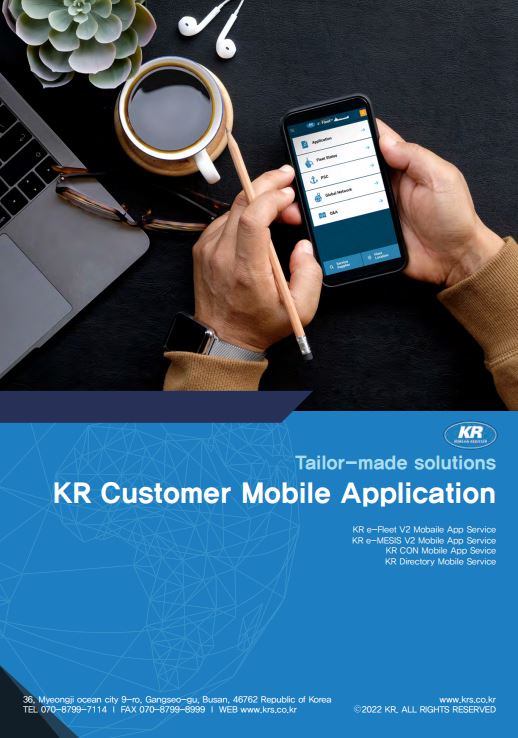
KR-DAON (Digital Application Online Network)

KR-DAON is the digital service integration platform of Korean Register. It provides a one-stop solution for customers to access KR's and maritime industry's digital services quickly and easily, promoting KR-centric digital service ecosystem development.

wp hosting wp hosting wp hosting wp hosting wp hosting

Brochure

Digital News

blog

KR, Hanwha Ocean Sign MOU for Joint Development of 18K LNG Bunkering Vessel

Sep 17, 2026

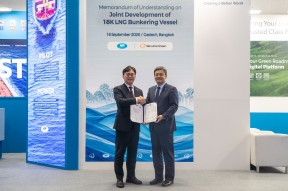
KR, Hanwha Ocean Sign MOU for Joint Development of 18K LNG Bunkering Vessel- Two cargo containment solutions target growing LNG bunkering demand -△ MOU signing for the joint development of an 18K LNG bunkering vessel at Gastech 2026 in Bangkok on September 16. (From left: Kyujin Yeon, Executive Vice President of KR; and Sangdon Kang, Executive Vice President of Hanwha Ocean) Korean Register (KR) signed a Memorandum of Understanding (MOU) with Hanwha Ocean to jointly develop two design concepts for an 18,000-cbm LNG bunkering vessel (LBV) on September 16 at Gastech 2026 in Bangkok.As international regulations on greenhouse gas emissions continue to tighten and the number of LNG-fueled vessels grows, the need for a stable LNG fuel supply infrastructure is also increasing. This is driving demand for LNG bunkering vessels capable of ship-to-ship LNG fuel transfer at sea.Under the agreement, KR and Hanwha Ocean will develop two design concepts for an 18,000-cbm LNG bunkering vessel, each featuring a different cargo containment solution to meet varying bunkering and operational requirements.The two concepts will incorporate MCTIB (High Manganese Steel Cargo Tank Independent Type-B), Hanwha Ocean’s LNG cargo tank solution, and independent Type-C tanks, respectively. The project aims to develop LNG bunkering vessel designs that combine reliable cargo operations with economic efficiency.Hanwha Ocean will lead the basic design and vessel performance assessment, overseeing the development of the cargo tank arrangement, LNG bunkering system and operational concept.KR will conduct a comprehensive review from the early design stage, assessing safety, regulatory compliance and operational efficiency in accordance with applicable international conventions and classification rules. Based on the results of this technical review, KR will also conduct an AIP assessment, supporting the technical reliability and future commercialization of the LNG bunkering vessel concepts.Sangdon Kang, Executive Vice President of Hanwha Ocean, said:"With the tightening of global environmental regulations and the growing number of LNG-fueled vessels, the LNG bunkering market's growth potential continues to expand. Through this joint development with KR, we aim to develop LNG bunkering vessel design capabilities that combine safety and economic efficiency, strengthening our competitiveness in the marine fuel supply market.”Kyujin Yeon, Executive Vice President of KR, added:“As the adoption of alternative-fueled vessels expands, the marine fuel supply infrastructure needed to support them will become increasingly important. KR will continue to work closely with shipyards and the wider maritime industry to support the commercialization of next-generation marine fuel supply technologies.”
blog

KR Grants AIP to HD Hyundai Heavy Industries for New 50K LPG Carrier

Sep 17, 2026

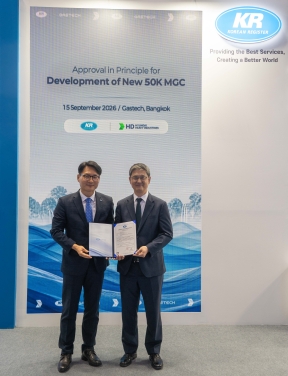
KR Grants AIP to HD Hyundai Heavy Industries for New 50K LPG Carrier- New vessel size bridges 45K- and 60K-cbm LPG carrier classes to meet growing mid-size demand -△ KR presents Approval in Principle (AIP) for the 50K LPG Carrier to HHI at Gastech 2026 in Bangkok on September 16. (From left: Pyungsham Cho, Senior Vice President of KR, and Hong-ryul Ryu, Senior Executive Vice President and CTO of HHI)Korean Register (KR) has granted Approval in Principle (AIP) to a newly developed 50,000-cbm LPG carrier, jointly designed with HD Hyundai Heavy Industries (HHI). The AIP was presented on September 16 at Gastech 2026 in Bangkok, Thailand.LPG carriers require precise control of cargo temperature and pressure to keep LPG cargo stable throughout storage and transport. Achieving both safety and cargo-loading efficiency in LPG transport calls for advanced engineering at every stage of design and construction. The new 50K design fills the gap between the established 45K and 60K designs, positioning it to serve the varied requirements of the mid-size LPG carrier segment. The vessel's design balances cargo-loading efficiency with operational economics, allowing it to adapt to a broader range of cargo volumes and trading patterns.The carrier features Type A independent tanks, which store LPG cargo separately from the ship's hull structure, ensuring stable storage and transport of the gas at low temperatures.Under the joint development project, HHI carried out the concept and basic design, while KR reviewed the design for compliance with applicable international standards and gas carrier regulations before issuing the AIP.Hong-ryul Ryu, Senior Executive Vice President and CTO of HHI, said:"Rising LPG trade volumes and increasingly diverse shipping routes have fueled growing interest in mid-size LPG carriers that offer efficiency and port accessibility distinct from larger vessels. This 50K-class carrier was developed in response to these market shifts and evolving transport needs. We will continue to diversify our vessel portfolio to stay ahead of emerging market demand and strengthen our competitiveness."Kyujin Yeon, Executive Vice President of KR, said:"Through this AIP for the 50K LPG carrier, KR has addressed the technical requirements of the mid-size LPG carrier market and laid the technical groundwork for developing new vessel types. We will continue to support the development of safe, efficient vessel technologies through ongoing technical collaboration with shipyards.

blog

KR and HD Hyundai Heavy Industries to Jointly Develop 3D Model-Based Approval Process for Ship Structural Design

Sep 16, 2026

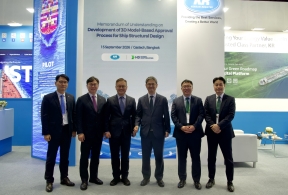
KR, HD Hyundai Heavy Industries, BAR Technologies and Liberian Registry Join Forces on Wind-Assisted LNG Carrier- New process aims to streamline ship design and classification approval -KR (Korean Register) signed a Memorandum of Understanding (MOU) with HD Hyundai Heavy Industries (HD HHI) at Gastech 2026 in Bangkok on September 15 for the joint development of a 3D Model-Based Approval (3DMBA) process for ship structural design.The project aims to establish a new approval framework that will enable 3D models used by shipyards for vessel design to be directly used for classification approval.While ship design is rapidly transitioning toward a 3D model-based environment, 2D drawings are still required for classification approval. As a result, shipyards must convert information already contained in their 3D design models into separate 2D drawings for class review.Under the MOU, KR and HD HHI will work to eliminate this duplication by developing a process that enables 3D design models to be used directly for classification review and approval.HD HHI will provide 3D ship design models and related data and conduct pilot applications on actual vessel projects to verify the practical applicability of the new process. KR will define the scope, review requirements and criteria for 3D model-based approval and develop a framework for assessing compliance with classification rules directly from the 3D model. The results of the pilot applications will also be incorporated into the process to further enhance its effectiveness and reliability.The two organizations expect the new approach to reduce the time and workload involved in preparing separate 2D drawings while also shortening the class approval process. The project will also strengthen KR’s capabilities in 3D model-based review and support the transition toward a next-generation digital classification approval framework.Hong-ryul Ryu, Senior Executive Vice President and CTO of HD HHI, said:“3D models have already become the standard for ship design, but the approval process still requires the preparation of separate drawings. This joint development project marks an important first step toward reducing duplicated work in the design process and creating an environment where design data can flow directly into classification approval.”Daeheon Kim, Executive Vice President of KR, said:“Moving the basis of ship design approval from 2D drawings to 3D models represents an important transformation in the way classification approval is carried out. Working with HD HHI, we will develop a practical approval framework based on actual design data that can be applied in real-world shipbuilding projects, enhancing efficiency for both shipyards and classification societies.”Following the project, KR and HD HHI plan to expand the 3D model-based design and approval framework to a wider range of vessel types and projects, with the aim of supporting its broader application across the shipbuilding industry.

blog

KR, HD Hyundai Heavy Industries, BAR Technologies and Liberian Registry Join Forces on Wind-Assisted LNG Carrier

Sep 16, 2026

KR, HD Hyundai Heavy Industries, BAR Technologies and Liberian Registry Join Forces on Wind-Assisted LNG Carrier- Joint project to assess the safety and regulatory compliance of WindWings® on a 174K LNG carrier -- Collaboration to advance the commercial application of wind-assisted propulsion technology -Korean Register (KR) has signed a Memorandum of Understanding (MoU) with HD Hyundai Heavy Industries (HHI), UK-based wind propulsion technology company BAR Technologies, and the Liberian International Ship & Corporate Registry (LISCR) to jointly develop a 174K LNG carrier equipped with the WindWings® wind-assisted propulsion system.The agreement was signed on September 15 at Gastech 2026 in Bangkok and aims to assess the technical feasibility and safety of applying wind-assisted propulsion technology to LNG carriers as the global shipping industry accelerates its transition toward decarbonization.The project will focus on a 174K LNG carrier developed by HHI featuring a forward accommodation arrangement. By positioning the crew accommodation block toward the bow, the design provides additional space on the upper deck, creating an opportunity to integrate BAR Technologies’ WindWings® system.WindWings® uses large, rigid wing sails installed on a vessel to harness wind as supplementary propulsion. By reducing reliance on the vessel’s main propulsion system, the technology can lower fuel consumption and greenhouse gas emissions while improving overall energy efficiency.Under the collaboration, HHI will lead the vessel’s basic design and design review, while BAR Technologies will provide technical data covering the arrangement and specifications of WindWings®, structural strength, operational concepts and expected fuel savings.KR, together with LISCR, will assess the safety and technical suitability of the design against applicable rules and international requirements. Based on the outcome of the assessment, KR will also consider granting Approval in Principle (AIP), supporting the application and future commercialization of wind-assisted propulsion technology on LNG carriers.Hong-ryul Ryu, Senior Executive Vice President and CTO of HHI, said: “We have continued to develop innovative hull forms and arrangement concepts for LNG carriers to advance environmentally friendly ship technologies. Through this project, we aim to integrate wind-assisted propulsion technology into our forward accommodation LNG carrier design, further enhancing the competitiveness of next-generation, low-emission LNG carriers.”John Cooper, CEO of BAR Technologies, said: “We already have WindWings® deployed across 10 bulkers and tankers, with 23 WindWings® collectively saving approximately 100 tonnes of CO₂ per day. We look forward to extending the application of WindWings® to next-generation gas carriers, establishing a robust foundation for safe commercialization, and providing shipowners with a genuinely attractive environmental solution.”Yongsok Lee, Chairman and CEO of KR, said: “Through this joint development project, KR will assess the safety and technical suitability of applying wind-assisted propulsion to this LNG carrier design against applicable rules and international requirements, with a view to granting Approval in Principle. By working closely with the shipyard, technology provider and flag administration, KR will continue to support the safe and reliable adoption of innovative technologies that contribute to the maritime industry’s decarbonization.”Alfonso Castillero, CEO of the Liberian International Ship & Corporate Registry, added: “This JDP reflects the Liberian Registry’s proactive approach to supporting the safe and responsible advancement of innovative maritime solutions. By assessing wind-assisted propulsion for LNG carriers from an early design stage, the partners can help translate the decarbonization challenge into practical opportunities for improved efficiency, future-ready ship designs and competitive advantage, without compromising safety or quality.”

blog

KR and HD Hyundai Samho Cut Structural Safety Review Time for Partial Launching with New Program

Sep 16, 2026

KR and HD Hyundai Samho Cut Structural Safety Review Time for Partial Launching with New Program- Automated structural modeling and load calculations enable faster structural safety assessments for partial launching- Eight-month joint development project validated through application to an actual vessel, with completion certificate presented at Gastech 2026KR (Korean Register) and HD Hyundai Samho have jointly developed a program that enables rapid assessment of hull structural safety during partial launching in the shipbuilding process.The two companies carried out the eight-month joint development project, titled “Automated Structural Analysis Program for Partial Launching Conditions Based on Direct Strength Analysis (DSA),” from February 2026. KR presented HD Hyundai Samho with a project completion certificate on September 14 at Gastech 2026 in Bangkok.Partial launching is a shipbuilding method in which a vessel is launched before construction is fully completed, with the remaining work carried out afterwards. This allows shipyards to make more efficient use of dock capacity and provides greater flexibility in construction schedules.However, because partial launching is carried out before hull block welding is fully complete or before certain structures are installed, the hull's weight and buoyancy distribution can differ from that of the completed vessel. This requires a close review of structural safety to confirm the hull can safely withstand the loads generated during launching.Until now, engineers had to build a separate structural analysis model excluding structures not yet installed at the time of partial launching and recalculate the resulting changes in loads and buoyancy, making the review process time-consuming.The newly developed program automates this process. Starting from the structural analysis model of the completed vessel, it automatically accounts for structures that are not yet installed or connected and generates an analysis model corresponding to the vessel’s actual construction status at the time of partial launching.The program also automatically calculates loads and buoyancy considering changes in hull weight and trim, enabling structural safety assessments to be carried out more quickly and efficiently.Under the project, HD Hyundai Samho provided the data required for program development, including partial launching scenarios and load conditions based on actual shipbuilding operations.Drawing on this information, KR developed functions based on Direct Strength Analysis to assess the loads acting on the hull and evaluate its structural strength and safety. HD Hyundai Samho subsequently applied the program to an actual vessel to verify its practical applicability in the field.Hakmu Shim, Executive Vice President of HD Hyundai Samho, said: “Partial launching is a critical process for a shipyard's dry dock efficiency and construction schedule, which makes it essential to confirm safety quickly and accurately. We expect this program to shorten the time required for structural safety reviews during partial launching and provide greater flexibility in dock operations and shipbuilding schedules.”Daeheon Kim, Executive Vice President of KR, said: “Through this joint development, we have secured the technology and standards to efficiently assess hull strength during partial launching. Building on this achievement, we will further strengthen our technical review and approval capabilities and continue to actively support safe and efficient shipbuilding at shipyards.”Going forward, the two companies plan to expand the scope of the newly developed assessment program to a wider range of ship types and partial launching scenarios, and to continue upgrading its capabilities for stability prediction and flexible response across different launching conditions.

blog

KR Launches AI-Integrated Technical Software Platform ‘SeaTrust Software Hub’

Mar 24, 2026

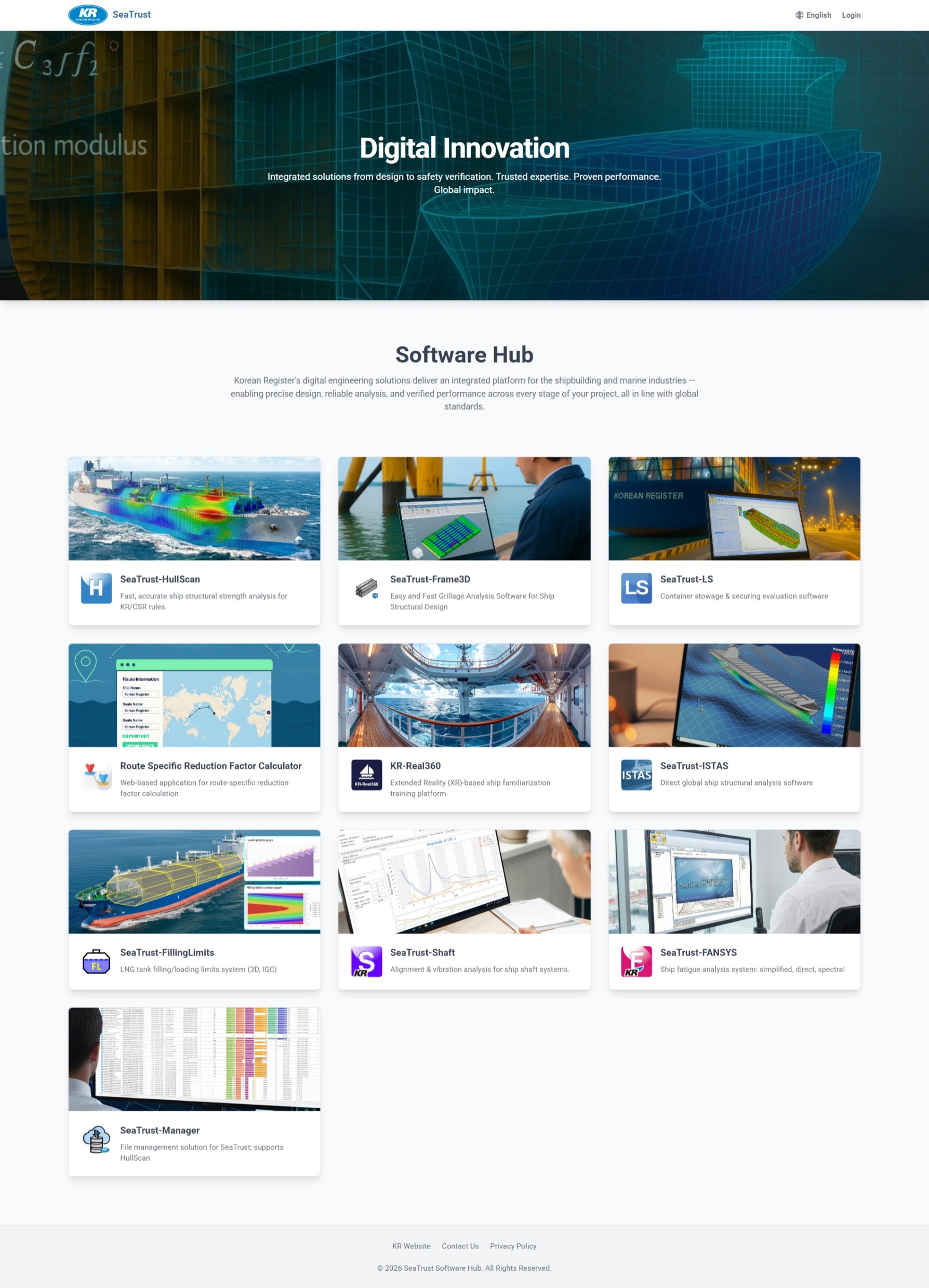
KR Launches AI-Integrated Technical Software Platform ‘SeaTrust Software Hub’ Korean Register (KR) has launched an upgraded version of its technical software platform, ‘SeaTrust Software Hub’, introducing an AI-integrated system designed to enhance user accessibility and strengthen customer support.SeaTrust Software Hub provides a more intuitive and structured interface for KR’s suite of technical software. It also enables users to manage the entire workflow, from software downloads and technical inquiries to feedback submission and improvement requests, all within a single integrated platform.A key highlight of the upgrade is the implementation of an AI-driven feedback processing system. The new platform analyzes user inquiries and automatically directs them to the appropriate team, helping KR respond more efficiently to customer requests.The AI system has been developed using extensive technical resources, including engineering documentation, user manuals, email correspondence and historical feedback records. By leveraging this data, the platform can generate context-aware responses to user inquiries.As inquiry data continues to accumulate, the AI system is expected to further enhance response speed, accuracy and quality over time.In addition, the website has been reorganized into a unified digital hub where users can search for and download all KR’s technical software solutions in one place. This includes SeaTrust-HullScan, a structural strength assessment software widely used by shipyards and design companies, as well as web-based applications such as the route-specific reduction factor calculator used by container shipping operators.Commenting on the launch, KIM Daeheon, Executive Vice President of KR, said the upgraded platform will strengthen the link between user feedback and technology development.“This upgrade significantly improves accessibility and user experience while enabling us to respond more quickly to customer feedback. By strengthening the connection between user input and our technology development and services, SeaTrust Software Hub will evolve beyond a software platform into a digital knowledge center where operational experience and technical expertise are systematically accumulated and shared.”SeaTrust Software Hub is available via the official website (https://www.seatrust.kr) and through KR-DAON (https://daon.krs.co.kr).

blog

KR unveils new digital platforms “PILOT” and “POWER” todrive data-based decarbonization in shipping

Nov 19, 2025

KR unveils new digital platforms “PILOT” and “POWER” todrive data-based decarbonization in shippingKR(Korean Register) has launched two new digital platforms, PILOT (Platform for Insightful LOw-emission Transitions) and POWER (Performance evaluation for Operational characteristics, Weather & aging Effect and fuel consumption Review), designed to support the shipping industry in developing optimal carbon-reduction strategies and enhancing operational efficiency.As the EU’s greenhouse gas regulations, EU ETS and FuelEU Maritime,are already in force, the delay in the International Maritime Organization’s(IMO) adoption of its Net-Zero Framework has heightened uncertainty over future global regulatory developments.Amid this complex landscape, shipping companies are seeking solutions that can help them evaluate various emission-reduction options and operational strategies based on objective data, while considering both cost and regulatory risks.Developed in response to these industry needs, KR’s new platforms enable efficient and data-driven decision-making for sustainable fleet management.PILOT allows users to design and assess customized greenhouse gas (GHG) reduction scenarios using each vessel’s technical specifications and operational data.The platform automatically calculates vessel-specific emissions and compliance costs based on actual emission data reported to the IMO and the EU, while evaluating the cost-effectiveness and reduction potential of introducing energy-saving devices (ESDs) and alternative fuels to recommend the most viable strategies. It also supports the establishment of mid- to long-term plans by simulating possible future regulatory developments.Meanwhile, POWER visualizes ship performance and fuel efficiency by analyzing data from the Automatic Identification System (AIS) along with weather and ocean condition information. This helps ship operators easily understand their vessels’ current operational status and identify areas for improvement, enabling them to formulate optimal, data-driven voyage strategies.LEEHyungchul, Chairman & CEO of KR said,“The shipping industry is facing the dual challenge of establishing practical emission-reduction strategies while improving operational efficiency under a changing regulatory environment. PILOT and POWER embody KR’s accumulated expertise and data-driven analytical capabilities, providing shipowners intelligence that enables informed decisions and promotes the sustainable development of the maritime sector.”KR-PILOT and KR-POWER are available through KR’s integrated digital service platform, KR-DAON (daon.krs.co.kr). △ PILOT’s dashboard △ POWER’s dashboard

blog

KR and HD Hyundai Samho Join Forces to Bring AI into Ship Design

Jun 18, 2025

KR and HD Hyundai Samho Join Forces to Bring AI into Ship Design KR (Korean Register) signed a memorandum of understanding (MOU) with HD Hyundai Samho on June 11 to jointly develop AI-based solutions for innovation in ship design and analysis.This partnership is a part of a broader digital transformation strategy aimed at enhancing design productivity and strengthening the capabilities of ship design engineers in the rapidly evolving shipbuilding landscape. The collaboration focuses on leveraging artificial intelligence to build a more efficient and accurate ship design system.The joint research initiative will focus on two core objectives:First, the development of an AI-powered optimization and structural assessment solution for hull support arrangement. Traditionally, determining the placement of these supports requires complex and repetitive computational analysis. Through this collaboration, the process will be automated using AI, enabling optimal arrangement of supports and providing a user-friendly interface that shows real-time simulation results under various input conditions.Second, the development of an on-premise design verification system powered by generative AI. This system will be based on a large language model (LLM) and will operate securely within the company’s internal network, in compliance with shipyard security requirements. By organizing accumulated shipbuilding knowledge and streamlining work processes across multiple departments, the system is expected to enhance both technical expertise and operational efficiency throughout the shipyard.KR and HD Hyundai Samho view this project as a starting point for the broader application of AI in ship design, and aim to expand the use of the core technologies developed to other areas of shipbuilding operations.SHIM Hak-mu, Executive Vice President of HD Hyundai Samho, stated, “This collaboration marks a pivotal step toward significantly advancing design efficiency and accuracy at shipyards through AI-driven automation. In particular, optimizing the arrangement of hull supports with AI and introducing a secure in-house design system will ease the workload for design engineers while enabling more consistent and precise outcomes?ultimately enhancing overall productivity and quality.”KIM Daeheon, Executive Vice President of KR, commented, “This joint development project represents a significant turning point in modernizing the ship design and analysis process using advanced AI technologies. KR remains committed to developing a wide range of AI-powered services not only in classification work but also across the broader shipbuilding and maritime sectors.”